




Air Duct Cleaning FAQ — Wilmington NC
Straight answers to the questions Wilmington homeowners and businesses actually ask us — pulled from real calls, real emails, and what people search for online. If your question isn’t here, call us at (910) 833-3828.
Air Duct Cleaning Questions
How it works, how often you need it, and whether it is actually worth the money in Wilmington’s coastal climate.
How often should I have my air ducts cleaned in Wilmington NC?
NADCA recommends cleaning residential air ducts every 3 to 5 years. In Wilmington NC, we usually recommend the closer-to-3-year end of that range because of our coastal humidity, year-round AC use, and the pollen that rolls off Greenfield Lake every spring. Homes with pets, smokers, recent remodels, allergy sufferers, or visible vent dust should go every 2 to 3 years.
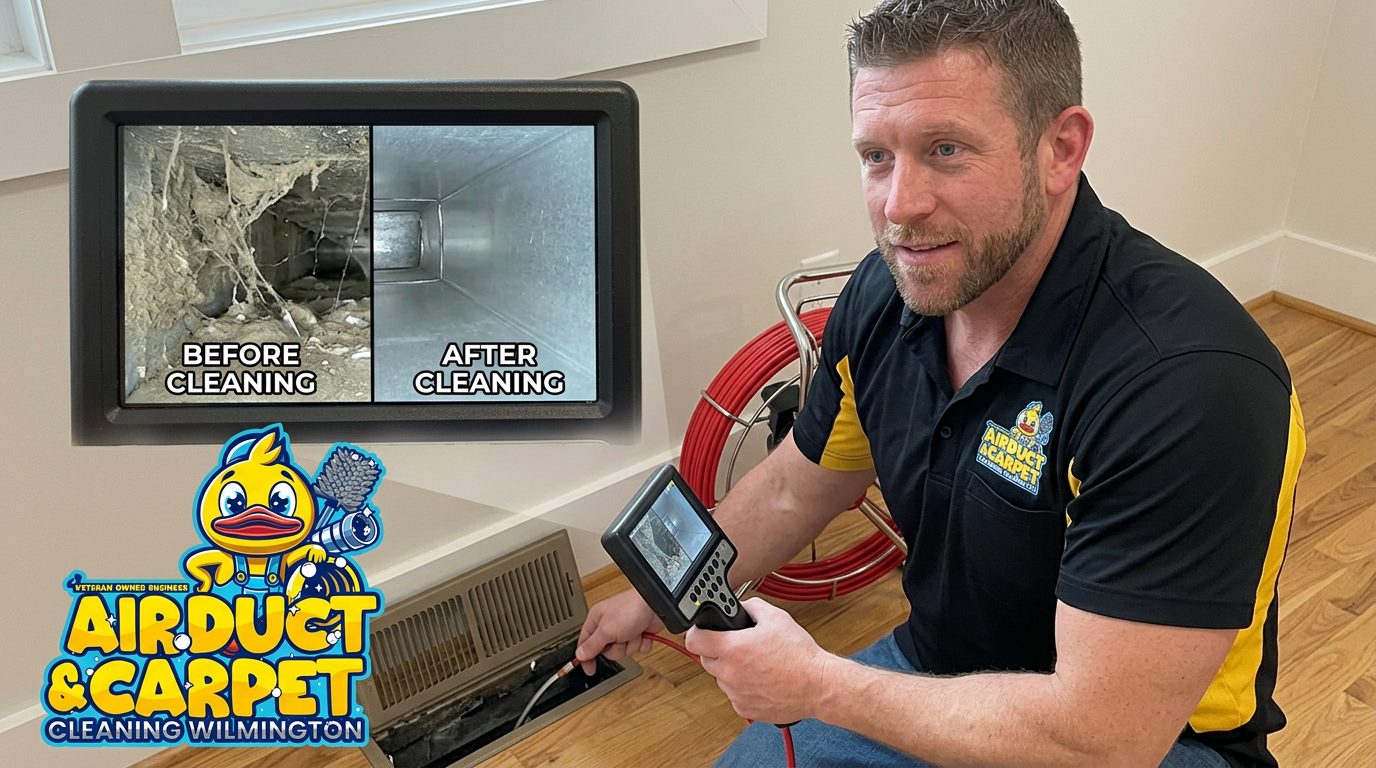
Before we commit you to a cleaning, we run a camera inspection. If the ducts are already clean, we say so and you pay nothing.
How much does air duct cleaning cost in Wilmington NC?
Residential air duct cleaning in Wilmington typically runs $350 to $750 depending on the number of supply vents, the size of the system, and whether the job includes dryer vent cleaning or coil cleaning as an add-on. Commercial quotes depend on system size, vent count, and facility access.
Every quote is free, written, and fixed before we start. No surprise fees when we arrive. Call (910) 833-3828 for an exact number for your home.
How much does duct cleaning cost in general — is it really under $100?
Any ad offering $49 or $99 whole-home air duct cleaning is a bait-and-switch. The honest range nationally is about $350 to $1,000 for a proper residential clean — NADCA-compliant equipment, negative-air vacuums, full source-removal brushing, and before/after camera footage cost money. If a company advertises a price that low, expect an upsell to three or four times that number once they are inside your home.
Is air duct cleaning a waste of money?
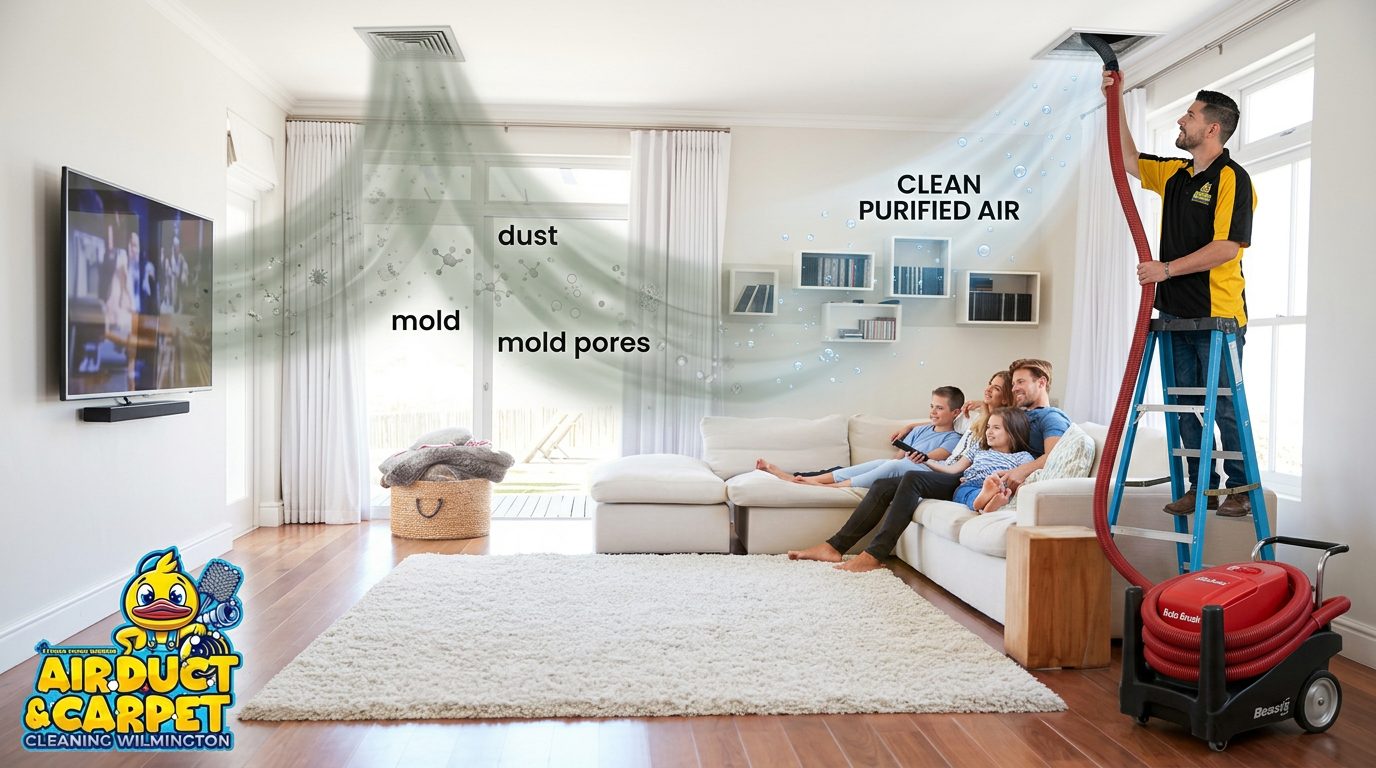
If your ducts are already clean, yes — which is why we inspect with a camera before we charge you. But Wilmington homes accumulate roughly 40 pounds of dust and debris per year in a six-room system. Left alone, that buildup reduces HVAC efficiency by 5 to 15 percent, traps allergens, feeds mold spores in our humid climate, and eventually gets blown back into the rooms where your family sleeps. Cleaning it makes a real, measurable difference. Letting a company clean ducts that don’t need it is the waste — that’s why our camera-first policy exists.
What is included in a professional air duct cleaning?
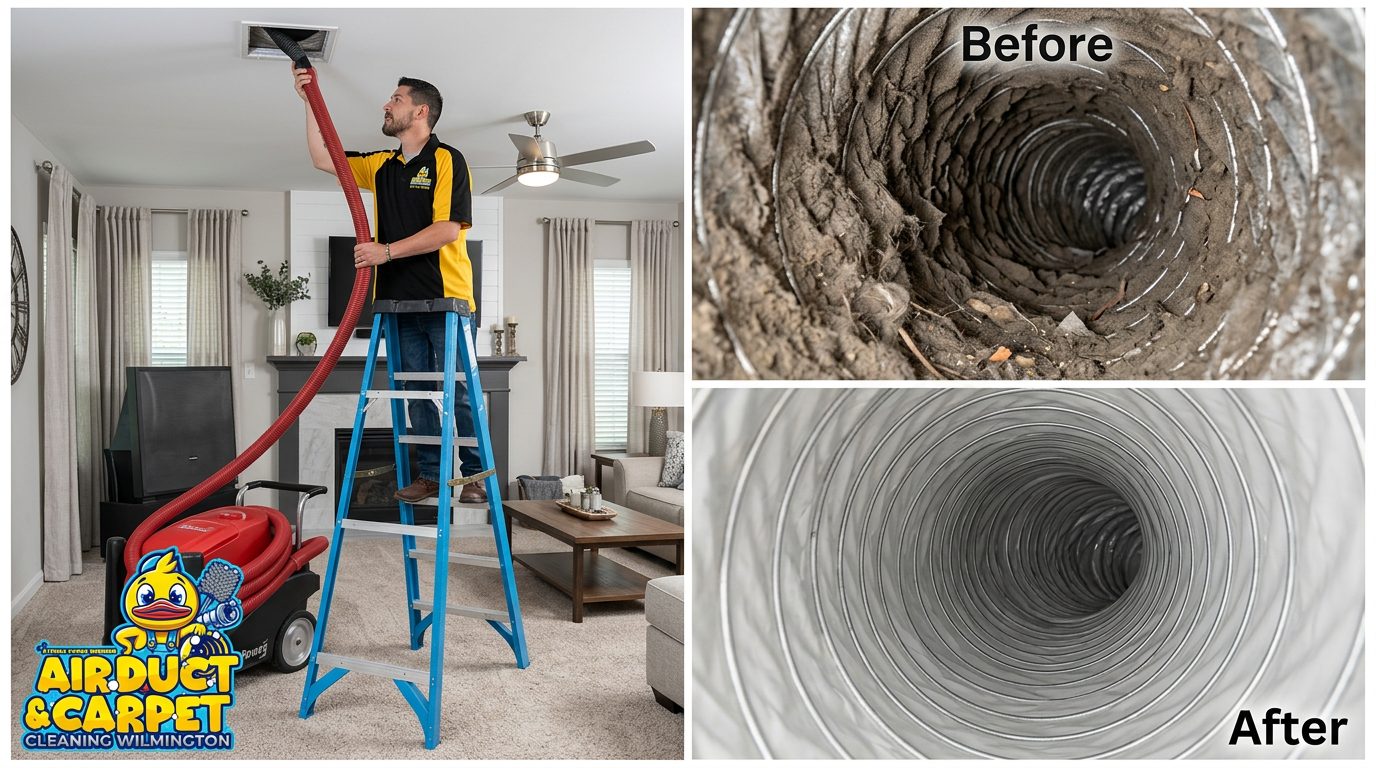
A professional clean includes: a pre-cleaning camera inspection, sealing and negative-air containment so dust doesn’t spread, rotating brush and compressed-air source removal on every supply and return, blower housing and evaporator-coil cleaning, a post-cleaning camera inspection so you see the work, and our included free antimicrobial fog treatment at the end. You’ll get before and after photos for every job.
Can I clean my air ducts myself (DIY)?
You can vacuum the vent covers and grilles — please do, every few months. But the actual ductwork, the blower housing, and the evaporator coil need a truck-mounted negative-air vacuum, source-removal brushes, and a borescope to do the job without kicking debris deeper into the system. A shop vac cannot generate the negative pressure needed. DIY-ing the full system is how a lot of homes end up with more dust than they started with.
How do you clean air ducts professionally? What is the process?
Our 6-step process: (1) camera-inspect the full system to confirm cleaning is actually needed, (2) seal the supply and return trunks so the negative-air vacuum pulls all debris in one direction, (3) use agitation tools — rotary brushes and air whips — to knock buildup off the duct walls, (4) clean the air handler cabinet, blower wheel, and evaporator coil, (5) re-run the camera so you can watch the before and after, (6) fog the entire system with an EPA-registered antimicrobial. Total job time is usually 3 to 5 hours.
How do you clean AC ducts and ductwork?
Same process as above — “AC ducts” and “ductwork” are just alternate names for the same supply and return system. The blower, coil, and ductwork are a connected loop, so we clean all three together. Cleaning just the vent openings without cleaning the trunk and blower only treats about 10 percent of the system.
How often should air ducts be cleaned if I have pets or allergies?
Every 2 to 3 years for pet households (dander and hair settle deep in the returns) and for anyone with asthma, allergies, or respiratory conditions. If you’ve had any renovation, sanding, or drywall work, schedule a clean within 30 days of completion, regardless of your last service date — construction dust is the single worst thing you can leave in a duct system.
How do I clean heating and air conditioning ducts myself?
For surface maintenance between professional cleans: remove each vent cover, vacuum the inside of the duct as far as a hose will reach, wash the covers in soapy water, and replace the air filter. That will handle the first 2 to 3 feet. The rest of the system — up to 100 feet of trunk line per HVAC unit — requires professional equipment.
Dryer Vent Cleaning Questions
Fire prevention, drying time, lint buildup, and when to call a pro instead of grabbing the vacuum.
How often should you clean your dryer vent?
At least once a year for an average 2-person household. Every 6 months for larger families, pet owners, or anyone whose dryer vent run is over 25 feet. Signs you’re overdue: clothes take two cycles to dry, the dryer is hot to the touch, the laundry room feels humid, or you notice a burnt smell during a cycle.
How long can a dryer vent be?
The International Residential Code allows a maximum of 35 feet of total vent length, with 5 feet deducted for every 90-degree elbow and 2.5 feet for every 45-degree elbow. In practice, we see a lot of Wilmington homes where the dryer is in a central closet and the vent run is right at or over this limit — which is why their clothes take forever to dry and lint packs the final 10 feet. If yours is over code, we can reroute or add a booster fan.
How much does dryer vent cleaning cost?
Residential dryer vent cleaning in Wilmington NC is typically $125 to $225 for a single-dryer home, and we usually bundle it with air duct cleaning for an additional $75 to $100 off. Second-story or rooftop vents are a little more because of the access. Every quote is fixed before we start.
How do I clean my dryer vent myself?
Basic maintenance you can do between professional cleans: (1) pull the dryer out from the wall and disconnect the flex hose, (2) vacuum the dryer-end port and the wall port as far as your hose will reach, (3) empty the lint trap every single cycle. A full cleaning of the rigid vent run — the pipe inside the wall and the exterior vent — requires a rotating brush kit on a 25-to-40-foot flex rod, which most homeowners don’t own.
The lint packed in the last 10 feet of the run, at the exterior hood, is the spot most DIY attempts miss. That’s where the fires start.
How do you clean a dryer vent from outside?
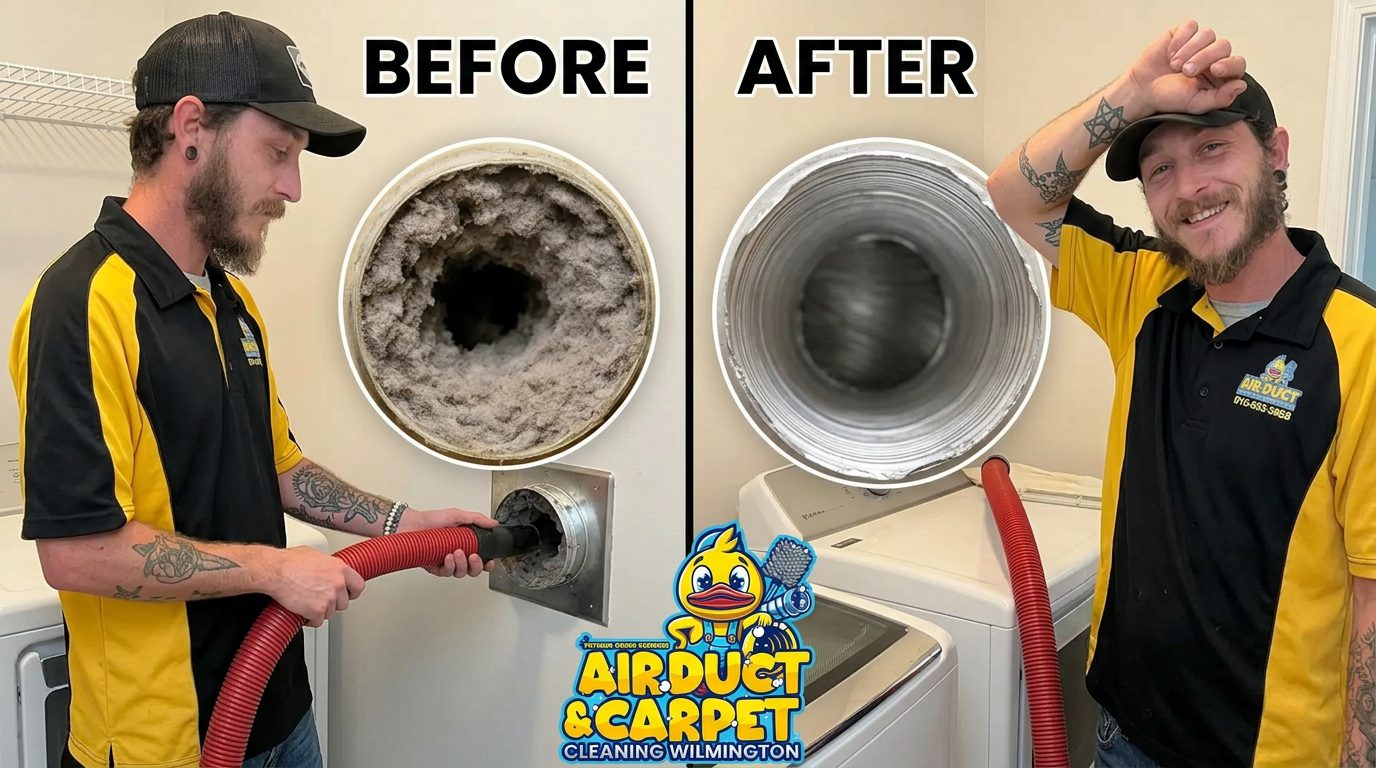
We clean from both sides. From the outside we remove the exterior wall or roof hood, run a rotating brush down the pipe, vacuum out dislodged lint, and inspect the flap. From the inside we disconnect the dryer, clean the flex hose and the wall port, and vacuum everything the outside pass dislodged. A one-direction clean misses about 30 percent of the lint.
How do you clean out the dryer duct or dryer vent duct?
“Dryer duct” and “dryer vent duct” both mean the rigid pipe that carries lint and moist air from the back of the dryer to the outside of the house. We use a flexible fiberglass brush rod on a drill, sized to the pipe diameter (usually 4 inches residential). We spin it through the entire run in sections, vacuuming the debris into a sealed HEPA vac at each end so none of the lint ends up in your laundry room.
How do I clean the lint trap on my dryer?
Every load: remove the screen, wipe or brush off the lint, slide it back in. Every few months: wash the screen in warm soapy water to remove dryer-sheet residue (that residue is invisible but it cuts airflow by about 30 percent). Let it fully dry before replacing.
How do I get lint out of my dryer?
Beyond the lint trap, lint collects in three other places: the lint trap slot itself (use a long narrow brush, or a vacuum hose with a crevice tool), the blower housing inside the dryer (requires a back-panel removal), and the drum seals. A professional dryer vent clean includes interior dryer cabinet cleaning on request — ask when you schedule.
Who cleans dryer vents in Wilmington NC?
We do — we’re Air Duct Cleaning Wilmington NC, veteran-owned, locally operated, 200+ five-star reviews, and recommended by 23+ of the top HVAC contractors in the Wilmington area. We service Wilmington, Leland, Carolina Beach, Kure Beach, Wrightsville Beach, Hampstead, and Rocky Point. Call (910) 833-3828 or book online.
How do I clean my dryer exhaust vent or exterior dryer vent?
The exterior hood is where most dryer fires start. Pop the hood open (usually two screws), pull out the visible lint with a gloved hand, wash the flap, check that it opens and closes freely. Inside the pipe, a quick pass with a vacuum extension will catch loose material but will miss anything packed. For a packed vent, you need a rotating brush — a pro clean is faster and safer.
How do I get the smell out of my dryer?
Musty or burnt smells in a dryer almost always mean lint buildup has started to scorch or has trapped moisture. Clean the lint trap, the lint-trap slot, and the exhaust vent, then wipe the drum with a vinegar-water mix and run an empty cycle on air-fluff. If the smell persists, the problem is usually moisture inside the vent run that’s not draining — we can diagnose and clean it in one visit.
Mildew smell in my laundry room — is it the washer or the dryer vent?
If the laundry room smells musty and clothes come out smelling worse than they went in, the problem is usually not the washer — it’s moisture backing up through a clogged dryer vent. Moist exhaust air hits cold winter walls, condenses, and sits in the pipe. Clean the vent and the smell goes.
Mold & Indoor Air Quality Questions
Musty AC smells, freon smells, mold in vents, and the Cape Fear coastal humidity problem.
Why does my AC smell musty or like mildew?
A musty or mildew smell the second you turn on the AC almost always means mold or bacterial growth inside the evaporator coil, the drain pan, or the first few feet of supply duct. Wilmington NC runs 60 to 80 percent outdoor humidity for most of the year — perfect mold conditions. We can confirm it with an air-quality test, clean the coil, sanitize the drain pan, and fog the duct system with an antimicrobial.
Why does my AC smell bad, stink, or smell like vinegar?
Common causes: (1) mold in the coil or ducts — musty smell, (2) a dead animal inside a duct run — rotting smell, (3) a blocked condensate line — sour or vinegar smell as water stagnates, (4) a burning electrical component — acrid smell, turn the system off immediately and call an HVAC tech. A camera inspection usually identifies the cause in the first 20 minutes.
Why does my AC unit smell like vinegar or sour milk?
Usually a clogged condensate line. Condensation from the coil pools and starts to ferment. Short term: flush the line with white vinegar through the access port (your HVAC tech can show you where). Long term: annual coil and drain-pan cleaning prevents the clog from forming.
Is mold in my air conditioner dangerous?
Yes, especially for children, older adults, and anyone with asthma, allergies, or compromised immune systems. When mold spores are in the evaporator coil or ductwork, every HVAC cycle blows them into rooms where your family breathes. Symptoms to watch for: coughing, sneezing, eye irritation, headaches, and fatigue that gets better when you leave the house. We test before we clean so we know what species we’re dealing with.
How do I get rid of mold in my air ducts?
Confirmed mold in ducts requires: (1) a third-party air-quality and surface swab test to identify the species and severity, (2) full source-removal duct cleaning with containment, (3) EPA-registered antimicrobial fog treatment, (4) a follow-up test to confirm the spore count is back to normal. We perform all four steps. For mold that’s spread into wall cavities or insulation we refer out to a remediation partner.
How do I remove mold from an AC unit or window AC?
For a window AC: unplug it, pull the front panel, wash the filter with warm soapy water, spray the coil with an EPA-registered mold cleaner (not bleach — bleach corrodes aluminum fins), let it sit 10 minutes, rinse with a spray bottle of water, air-dry for 24 hours before reinstalling. For a central AC, you need a trained tech with a coil comb and anti-microbial cleaner — the coil is too delicate for DIY scrubbing.
How do I clean mold from an air conditioner?
Surface-level (vents, grilles): wipe with a 1:10 vinegar-water solution. Coil and pan (central AC): use an EPA-registered HVAC-specific cleaner like EnviroCon or BBJ MRC, never bleach. Ductwork: requires professional fogging. If you can smell mold when the system is running, cleaning the vents alone won’t fix it — the source is deeper.
What does freon smell like and can it cause mold smells?
Freon (refrigerant) has a faintly sweet, chloroform-like smell. It’s not the same as the musty smell of mold. A freon leak is rare but serious — if your AC suddenly stops cooling and you notice a sweet chemical odor, turn the system off and call an HVAC tech, not a duct cleaner. Freon does not smell like mildew or vinegar.
Does freon gas have an odor?
Pure freon is essentially odorless. Modern refrigerants (R-410A, R-32) have a faint chemical sweetness only detectable in concentrated leaks. Any strong smell coming from the AC is almost always NOT freon — it’s mold, burned electrical, or stagnant condensate water. The good news is those three are all fixable.
Can a smelly AC condenser cause odor in the house?
Yes — if the outdoor condenser has debris or rodent nesting, it can draw bad air in through the return side of the system and push it into the house. We inspect the outdoor unit as part of every service call and can clear bird nests, yellow jacket nests, and plant overgrowth that causes the problem.
How do I get rid of a musty smell in my house?
Musty house smell in Wilmington NC usually traces to one of four sources: (1) mold in the HVAC coil or ducts, (2) crawlspace moisture pushing up through return leaks, (3) a damp carpet acting as a reservoir that the HVAC re-circulates, or (4) bathroom/kitchen exhaust venting into an attic instead of outside. We inspect all four and tell you which it is. Air-freshener plug-ins only mask the problem.
How do I get a musty smell out of my car or get rid of mildew smell in a car?
We don’t service vehicles, but the same principles apply: run the AC on recirc with the fan on max for 10 minutes, spray an automotive-rated antimicrobial into the cabin air intake (under the passenger-side dash), replace the cabin air filter, and steam-clean the upholstery. A stubborn smell usually means the evaporator drain is clogged — an auto shop can clear that.
How do you clean a window AC unit?
Unplug it first. Pull the filter and wash with warm soapy water. Vacuum the coil with a soft brush attachment. Spray an EPA-registered HVAC cleaner on the coil (not bleach), let it sit, rinse with a spray bottle. Clean the drain tray. Air-dry for 24 hours before plugging back in. A DIY clean every season and a professional deep-clean every 2 years will keep a window unit running cleanly.
Camera & Video Inspection Questions
How the camera works, what we look for, and why we run it both before and after every job.
What is an air duct camera inspection and how does it work?
We send a flexible borescope camera with its own LED light ring down your trunk line and into the supply and return branches. You watch the live feed on a monitor next to us. We document the full length of the ductwork, mark hot spots (heavy dust, mold growth, rodent nests, disconnected joints), and save the video so you can see it again later. Total inspection time is 30 to 60 minutes depending on system size.
Will I see before and after photos?
Every job, every time. We run the camera before the clean so you see what we’re dealing with, and after the clean so you see the result. If your ducts don’t actually need cleaning, the pre-inspection will show that and we’ll tell you — you pay for the inspection only, no pressure to proceed.
How often should air ducts be camera inspected?
We include an inspection in every cleaning visit, so if you’re on the 3-to-5-year cleaning cycle you’re covered. Standalone inspections make sense when you: just bought a home and want to know what’s in the system, suspect mold but can’t prove it, or had a recent renovation and want to confirm the ducts didn’t collect drywall dust.
Is camera inspection the same as ductwork inspection or video inspection?
Yes — “camera inspection,” “video inspection,” and “ductwork inspection” are three names for the same service. “Duct assessment” is the broader term we use when we combine camera footage with airflow measurements and static-pressure readings.
Do you offer dryer vent camera inspection?
Yes. A dryer-vent-specific camera is thinner than the duct camera and designed to navigate the 4-inch pipe. We use it to confirm how packed the vent is, locate any collapsed sections, and verify the exterior hood flap is operating. Often included free when you book a dryer vent cleaning.
Why pay for a camera inspection instead of just cleaning?
Because you shouldn’t pay for a cleaning you don’t need. We’ve talked more than a few Wilmington homeowners out of a duct cleaning after the inspection showed clean ducts. We’d rather build trust and earn the next job than charge for one that isn’t justified. It’s why 23+ local HVAC companies refer their customers to us.
Restaurant Hood & Exhaust Cleaning Questions
Fire code compliance, schedule frequency, and what is actually included in a commercial clean.
How often should restaurant hoods be cleaned?
Per NFPA 96: quarterly for most full-service restaurants, semi-annually for moderate-volume kitchens (pizza, deli), annually for low-volume kitchens (church kitchens, seasonal). Monthly for solid-fuel cooking (wood/charcoal) or 24-hour operations. Your insurance carrier and local fire marshal may require a stricter schedule — we’ll match whatever compliance standard you’re held to.
How much does restaurant hood cleaning cost?
Pricing depends on hood size, grease load, duct run length, and rooftop fan accessibility. A single-hood small restaurant in Wilmington typically runs $300 to $550 per cleaning. Multi-hood full-service kitchens range from $600 to $1,500. Every quote is written and fixed, with a copy of the compliance certificate provided after the job so you can file with your insurance and fire marshal.
How do you clean a restaurant hood or hood vent?
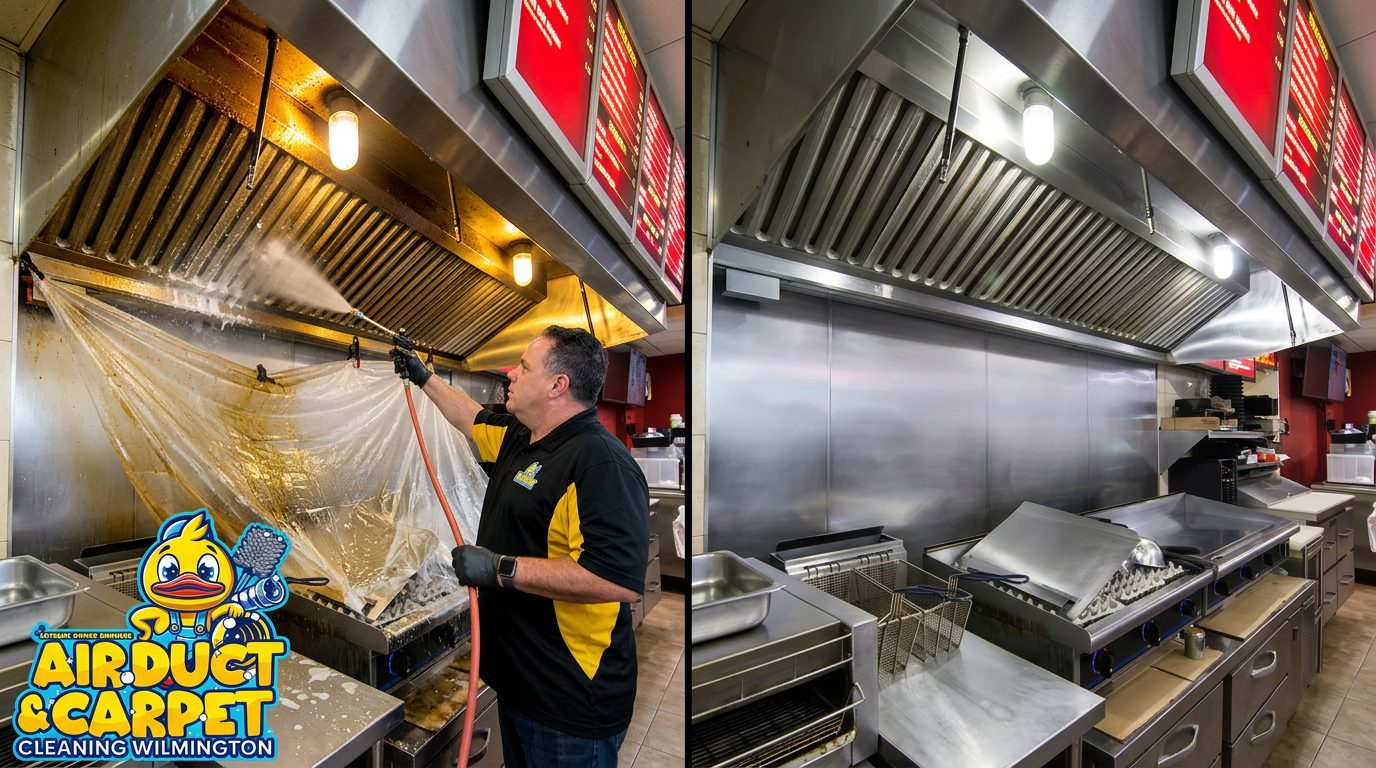
Our compliant process covers the hood interior, filters, plenum, duct run, and rooftop exhaust fan. We scrape heavy grease, apply a commercial-grade degreaser, pressure-rinse, and scrape again until the bare metal shows. We photograph before and after each component and leave you with a signed compliance certificate and photo packet. Total time: 2 to 4 hours per hood depending on load.
How do I clean an exhaust hood between professional cleanings?
Daily: wipe the exterior surfaces and the lip of the hood. Weekly: pull the baffle filters, soak overnight in a heated degreaser, scrub and rinse, dry and reinstall. This doesn’t replace NFPA 96 certified cleaning, but it keeps the grease load manageable between visits and extends filter life.
Do you clean commercial kitchen exhaust systems?
Yes — full NFPA 96 compliance, from hood through ductwork up to and including the rooftop exhaust fan. We serve Wilmington, Leland, Carolina Beach, Wrightsville Beach, Hampstead, and Rocky Point. We provide the fire-code compliance sticker and photo report after every clean.
Pricing, Scheduling, and About Us
Who we are, where we serve, how quickly we can be out, and how to get a real number before we start.
Are you licensed and insured?
Yes — fully licensed in North Carolina, bonded, and insured with a $1M commercial general liability policy. NADCA-trained on residential, IKECA-style protocols on commercial hood work. We send certificate-of-insurance documentation on request for property management companies.
Do you offer same-day service in Wilmington NC?
Yes — same-day slots are available most weekdays for dryer vent cleanings and urgent mold inspections. Air duct cleanings usually schedule within 48 hours. Call (910) 833-3828 before 10 AM for the best chance at a same-day booking.
What areas do you service?
Wilmington, Leland, Carolina Beach, Kure Beach, Wrightsville Beach, Hampstead, Rocky Point, and Burgaw. Outside that area, call and ask — we’ll tell you honestly whether we can make the trip worthwhile for both of us.
Do you service commercial properties?
Yes — restaurants, office buildings, multifamily/apartment buildings, medical offices, daycares, and schools. Commercial scheduling is flexible (after-hours, weekends) to avoid disrupting your operations. For multifamily buildings we offer bulk-unit pricing when cleaning 10+ units in a single visit.
How quickly can you come out?
Typical response: same-day to 48 hours for Wilmington, Leland, Carolina Beach, Wrightsville Beach. 1 to 3 days for Hampstead, Rocky Point, Kure Beach. Emergency calls (mold smell, dryer fire risk, post-flood) bump to the top of the schedule — call and tell us the situation and we’ll work you in.
Do you offer free written estimates?
Every time. No-charge phone estimates for most residential jobs, no-charge on-site estimates for commercial work and anything complicated. All pricing is fixed in writing before we start — no change orders after we’re on the truck, no surprise add-ons at the end.
What sets you apart from other Wilmington NC duct cleaners?
Three things: (1) camera proof before and after every job — if the ducts are clean, we tell you and you pay nothing; (2) veteran-owned and locally operated — your job is run by people who live in Wilmington, not a franchise dispatcher in another state; (3) 23+ HVAC companies in Wilmington refer their customers to us because they know we won’t upsell or misdiagnose — our reputation with the pros is the reason we’re still here.
What should I watch out for with duct cleaning scams?
Biggest red flags: (1) $49 or $99 “whole-home” advertised pricing — it’s always a bait-and-switch; (2) door-to-door canvassers claiming they noticed “dust” from the street; (3) refusal to provide a written estimate up front; (4) pressure to sign a contract before inspection; (5) no camera, no before/after photos; (6) no local address, no local phone. We have a full page covering this at Air Duct Cleaning Scams.
Do you offer maintenance plans?
Yes — annual maintenance plans cover dryer vent cleaning, UV bulb replacement, filter swaps, and a free mid-cycle camera check. Typical plan runs $200 to $400 per year depending on how many services you bundle. Call and we’ll put together a plan that matches your home.
Who do I call with more questions?
Call (910) 833-3828 during business hours, or email us through the contact page. If you text the number we usually respond within an hour during the day. We’d rather answer a question before you book than have you discover an issue on the day of service.
Still have a question? Call us — we actually answer.
No phone tree, no sales script. You’ll talk to a real Wilmington NC technician who can give you a real answer.